
Herpesviruses
Human Herpesvirus 6
Human herpesvirus 6 (HHV-6) comprises two closely related species, HHV-6A and HHV-6B, belonging to the genus Roseolovirus of the family Herpesviridae.
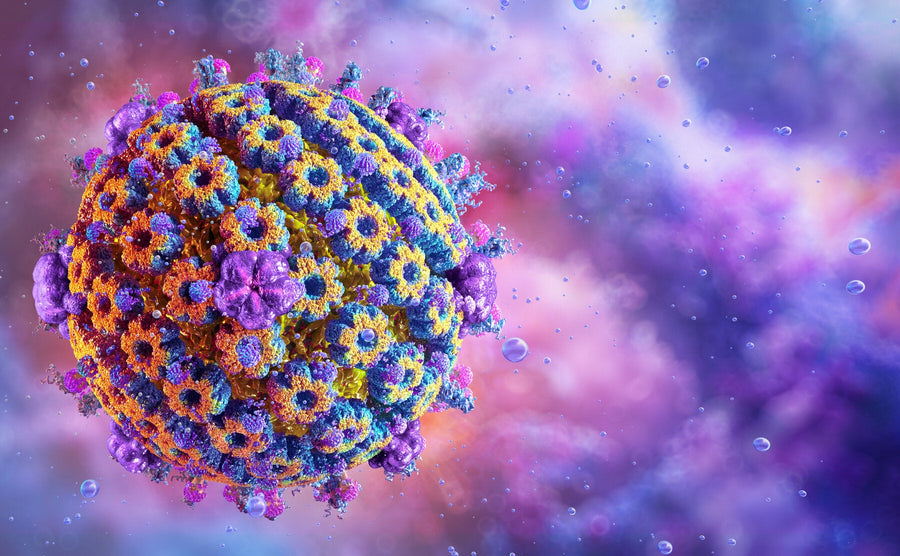
O patogenu
Human herpesvirus 6 (HHV-6) comprises two closely related species, HHV-6A and HHV-6B, belonging to the genus Roseolovirus of the family Herpesviridae. Primary infection most commonly occurs in early childhood, and the majority of the population is seropositive by adulthood. HHV-6B is the causative agent of exanthema subitum (roseola infantum, sixth disease), typically characterized by sudden-onset fever followed by a maculopapular rash. The infection may also be associated with febrile seizures. Following primary infection, the virus persists in the body lifelong in a latent form. Its genome can integrate into the telomeric regions of host chromosomes and, in a proportion of the population, may also be inherited, which is important to consider when interpreting laboratory results.
In immunocompetent individuals, HHV-6 usually remains clinically silent, but reactivation may occur when the immune system is weakened, particularly in patients following hematopoietic stem cell or solid organ transplantation. Reactivation may be associated with fever, suppression of hematopoiesis, and serious complications, particularly central nervous system involvement, including encephalitis. Serological detection of anti-HHV-6 IgG and IgM antibodies provides information on immune status and the stage of infection; seroconversion or a fourfold increase in antibody titre in paired samples supports evidence of active infection. In cases of neurological involvement, specific IgG antibodies can also be assessed in serum and cerebrospinal fluid, including evaluation of their intrathecal synthesis.
VIDIA brings a unique solution to HHV-6 serological diagnostics worldwide: as the only company in the world offering certified immunochemical assays for the detection of anti-HHV-6 IgG and IgM antibodies.
Portfolio
Dostupné assays
Portfolio pro tento patogen průběžně doplňujeme. Napište nám na obchod@vidia.cz a pošleme dostupné varianty.
Časté otázky
Často kladené otázky
What is HHV-6 and why is it tested?
Human herpesvirus 6 comprises two closely related human herpesviruses, HHV-6A and HHV-6B. HHV-6B is the classic cause of exanthema subitum (roseola infantum, sixth disease), which most often appears in children roughly between 6 and 24 months of age. Primary infection is typically characterized by a sudden high fever lasting several days, after which a maculopapular rash may appear; some children may experience febrile seizures. After primary infection, HHV-6 persists in the body for life and can subsequently reactivate. In immunocompetent individuals, reactivation is usually clinically insignificant, while in immunocompromised patients, especially after allogeneic hematopoietic cell transplantation, HHV-6B reactivation can be associated with serious complications, above all encephalitis. Current data also show an association between HHV-6B reactivation after HCT and increased morbidity and mortality. Serological testing allows evaluation of the specific IgM and IgG antibody response, while in neuroinfections a paired examination of serum and CSF can also be used to assess intrathecal synthesis of anti-HHV-6 IgG.
What is the difference between PCR and serological ELISA testing for HHV-6?
PCR and serology provide different information. PCR directly detects viral DNA, while ELISA evaluates the patient's immune response through specific antibodies. Interpreting HHV-6 PCR has one important peculiarity: the complete HHV-6 genome can be integrated into the telomeres of human chromosomes and inherited in the germline, known as inherited chromosomally integrated HHV-6 (iciHHV-6). This condition occurs in approximately 0.2 to 1% of the population and can cause persistently high HHV-6 DNA positivity without active viral replication. A positive PCR finding alone, especially from whole blood or cellular material, therefore does not necessarily mean active infection. When reactivation is suspected in an immunocompromised patient, quantitative PCR in a clinically relevant material and assessment of viral load dynamics are therefore essential. In transplant medicine, PCR is the main diagnostic method; current recommendations even state that serology is not suitable for diagnosing HHV-6 reactivation in patients after HSCT. Serology has a different role: it documents prior exposure and the dynamics of the humoral response, and can be useful in diagnosing primary infection, evaluating paired sera, or combined with testing for intrathecal antibody synthesis. The result must always be interpreted together with the clinical picture and other laboratory methods.
When is the IgG test used and when the IgM test?
IgM antibodies appear early in the course of the immune response, according to VIDIA data already within the first week, and support suspicion of recent or ongoing infection. Their interpretation is not, however, absolutely specific for primary infection; an IgM response can also be detected during reactivation. IgG antibodies develop later, approximately during weeks 2 to 3, and then persist long term, usually for life. Given the very high seroprevalence of HHV-6, isolated IgG positivity in an adult is therefore an expected finding and does not by itself prove active infection. In children, when primary infection is suspected, it may be more appropriate to assess seroconversion or a significant change in antibody levels in paired samples. In neurological complications, anti-HHV-6 IgG can also be determined in CSF, and testing serum at the same time allows an antibody index to be calculated, which helps document intrathecal synthesis of specific IgG.
What type of sample does the test require?
anti-HHV-6 IgM: serum or plasma. anti-HHV-6 IgG: serum or plasma. anti-HHV-6 IgG for intrathecal synthesis: paired sample of serum and cerebrospinal fluid (CSF). ELISA-VIDITEST anti-HHV-6 IgG allows semi-quantitative and quantitative evaluation as well as testing for intrathecal synthesis; IgM is intended for semi-quantitative evaluation in serum/plasma.
How long does it take to get a result?
For ELISA-VIDITEST and MONO-VIDITEST anti-HHV-6, the analytical protocol is unified to 30/30/15 minutes, that is 75 minutes of incubation. Sample preparation and dilution, washing steps and photometric reading must be added to this.
Why is VIDIA the only manufacturer of an HHV-6 test worldwide?
In infants the disease is usually easy to recognize clinically, so there was long no urgent market demand for a serological ELISA test. The clinical significance of HHV-6 is growing, however, particularly in patients with weakened immune systems, whose numbers are increasing, and demand for the test is growing with it. Running an ELISA test as part of risk stratification in immunodeficient patients is cheaper than dealing with the far higher costs associated with the consequences of virus reactivation.
Does the test detect both HHV-6A and HHV-6B?
VIDIA kits are intended for determining antibodies against HHV-6, not for serological typing of HHV-6A and HHV-6B. The two viruses are antigenically very closely related (approximately 95% sequence homology), and current serological methods generally cannot reliably distinguish the antibody response against HHV-6A from HHV-6B. The ELISA result is therefore interpreted as anti-HHV-6 IgG or IgM, not as anti-HHV-6A or anti-HHV-6B.
Nenašli jste, co hledáte?
Pomůžeme Vám najít vhodné diagnostické řešení
Popište nám, co potřebujete vyšetřit, a náš produktový tým Vám pomůže najít vhodné diagnostické řešení. Odpovíme Vám do 24 hodin.
Preferujete e-mail? Napište nám na obchod@vidia.cz